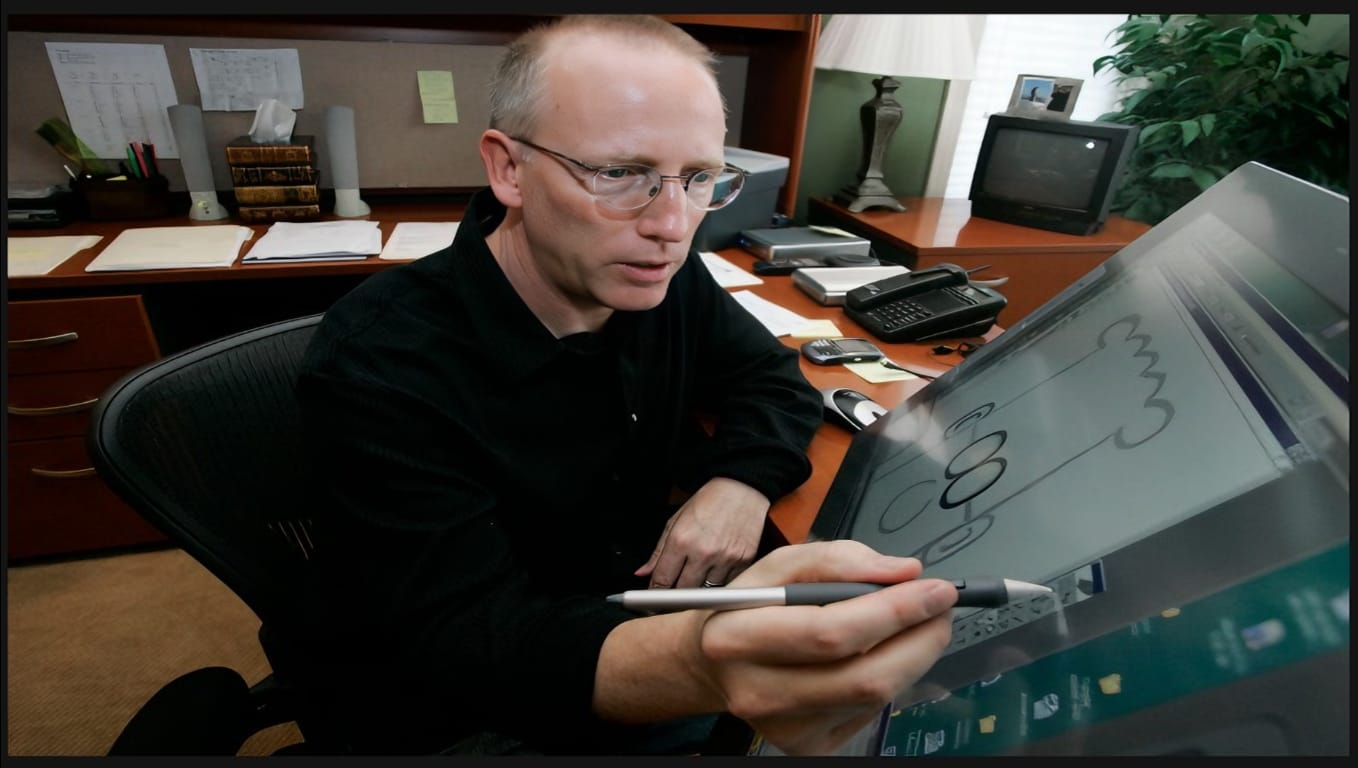
If you’ve ever had a boss who didn’t understand what you did for a living or a printer that seemed to sense your fear, you didn’t just read Dilbert—you lived it.
For decades, Scott Adams wasn’t just a cartoonist; he was the guy whispering, “You aren’t crazy, this office is actually absurd,” from the funny pages.
Yesterday, the news broke that Adams passed away at the age of 68. And while his later years were filled with headlines of a very different kind, I think it’s time we pause to talk about the man who changed the way we look at our cubicles forever.
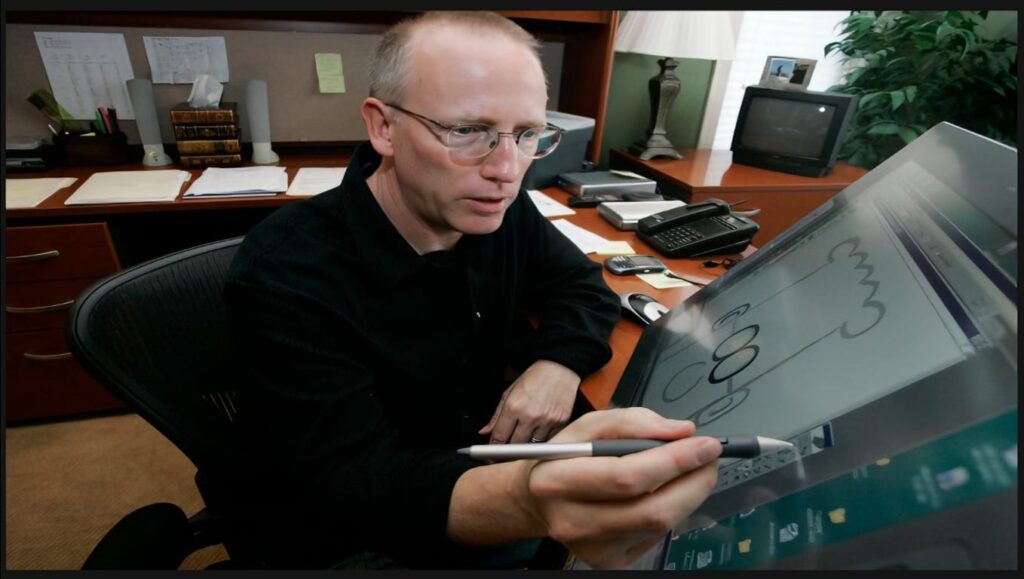
Scott Adams
“Inside the Pleasanton home office, where Scott Adams satirized the world.”
The News: What We Know
According to reports confirmed by his family, Scott Adams passed away on January 13, 2026, following a battle with cancer.
While the world knew him as a media figure, at his core, he was a former Pacific Bell employee who turned his corporate frustrations into an empire. At its peak, Dilbert appeared in over 2,000 newspapers in 65 countries.
Why Dilbert Mattered (The “Me Too” Factor)
Before The Office gave us Michael Scott, we had Pointy-Haired Boss.
I remember my first “real” job in the early 2000s. I walked into the breakroom, and someone had taped a Dilbert strip to the microwave. It was the one where Dogbert explains that “leadership is nature’s way of removing morons from the productive flow.”
I laughed out loud. I felt seen.
Adams gave us a vocabulary for our misery. He coined terms that evolved into established business theories:
- The Dilbert Principle: The idea that companies tend to promote incompetent employees to management to keep them out of the workflow.
- The Cubicle Farm: He didn’t invent the cube, but he defined the soul-crushing grey aesthetic of it.
For a long time, Adams was the unofficial therapist for every white-collar worker in America.
The Complicated Legacy: Addressing the Final Years
However, to write an honest tribute to Scott Adams, we cannot simply look at the funny pages and ignore the headlines. The truth is, the legacy of Dilbert became inextricably linked with the personal views of its creator in his final years.
Starting around 2015 and culminating in February 2023, Adams’ voice shifted from corporate satire to provocative political commentary.
The turning point came during an episode of his online show, where remarks regarding race relations led to an immediate and widespread backlash. Within days, hundreds of newspapers—including The Washington Post and The Los Angeles Times—dropped the comic strip. The corporate world that Adams had spent a lifetime satirizing effectively fired him.
For many fans, this was a moment of genuine heartbreak.
It created a difficult divide:
- The Nostalgia: We remembered the joy of cutting out a strip that perfectly described our micromanaging boss.
- The Reality: We had to reconcile that joy with the divisive rhetoric of the man behind the pen.
Ultimately, Adams leaves behind a dual legacy. He was a pioneer who changed the way we look at office life, but he also serves as a stark reminder that in the modern era, the art and the artist are rarely allowed to remain separate.
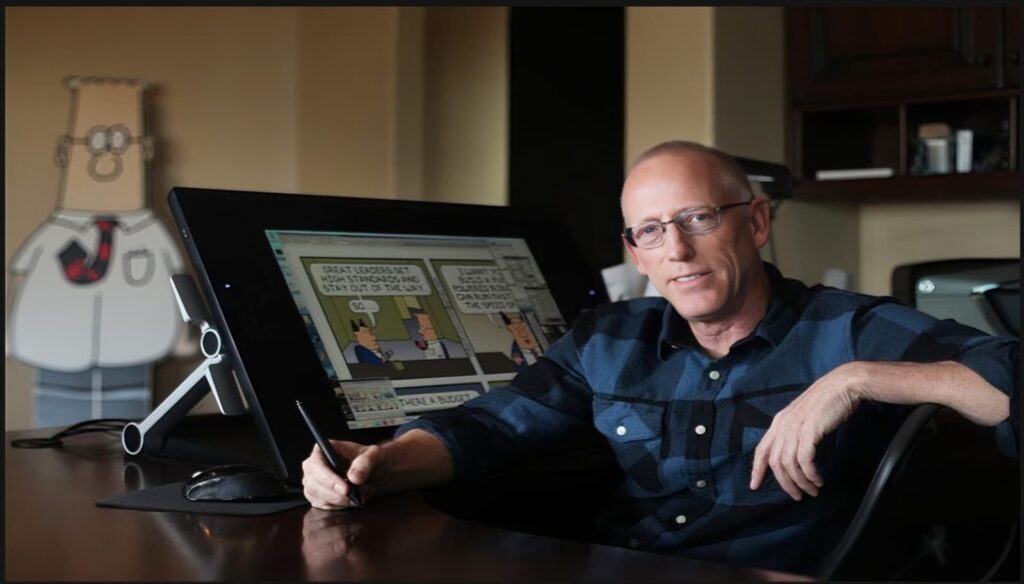
Cartoonist Scott Adams
The man who hated the office, working from home. Cartoonist Scott Ada
Can We Separate the Art from the Artist?
This is the question many of us are asking today.
Can you still laugh at a 1998 strip about “marketing guys” even if you disagree with the creator’s politics in 2024?
I think the answer is personal. But I also believe that once art is released into the world, it belongs to the audience, not the creator. Dilbert belongs to every engineer who had to explain email to a CEO. It belongs to every admin who had to fix the copier.
Scott Adams, the man, was a complicated, controversial, and deeply polarizing figure. But the world he drew—the world of pointy-haired bosses and clueless consultants—was universally understood.
What Do You Think?
It’s a heavy topic, and I know feelings are mixed today.
I’d love to hear your take. Do you have a favorite Dilbert strip that sat on your desk for years? Or did the controversy make it impossible for you to enjoy the comic?
Let me know in the comments below.