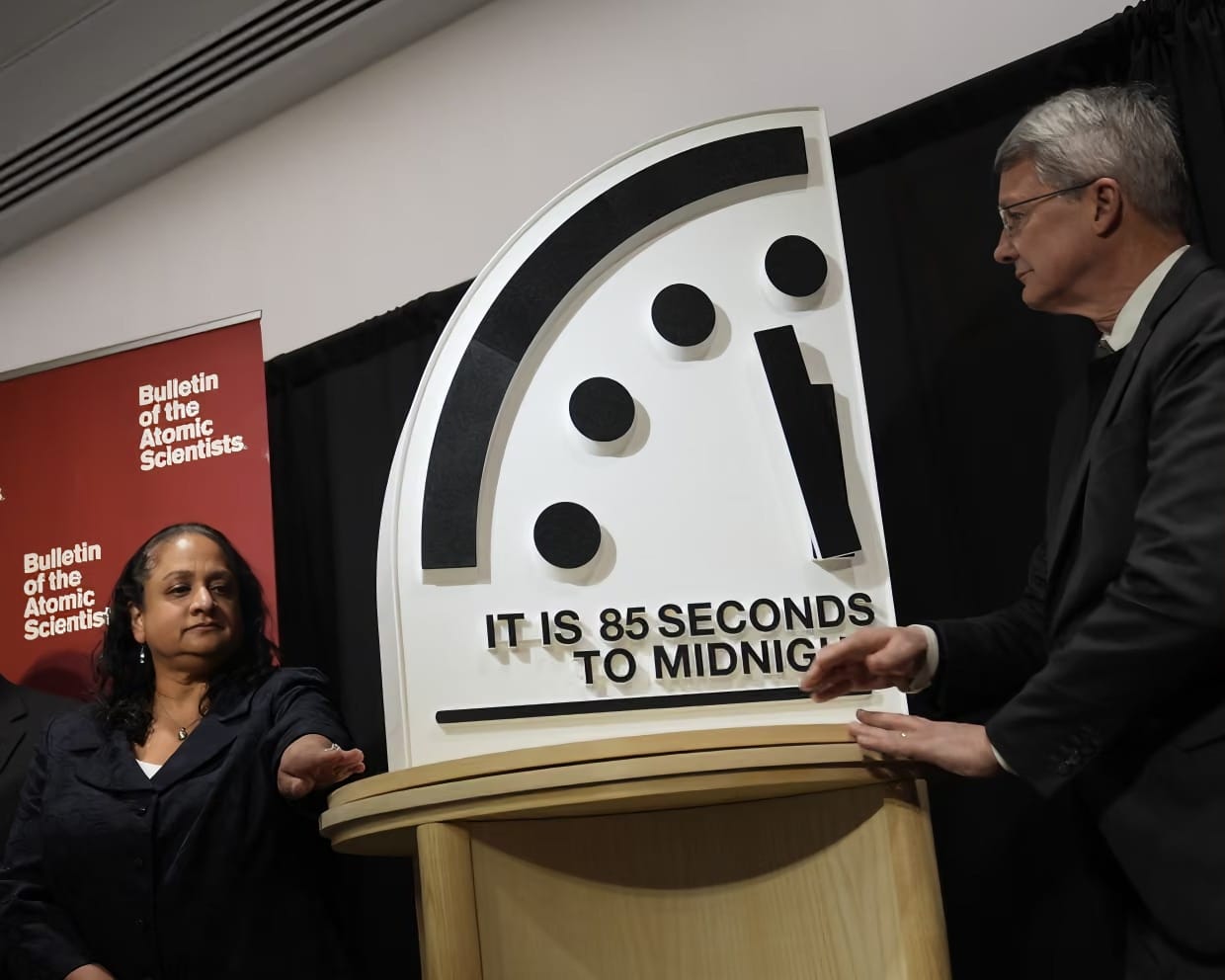
The Bulletin of the Atomic Scientists has reset the Doomsday Clock to 85 seconds to midnight, the closest it has ever been to global catastrophe. Find out why nuclear risks, climate change, and AI threats forced this historic move in January 2026.
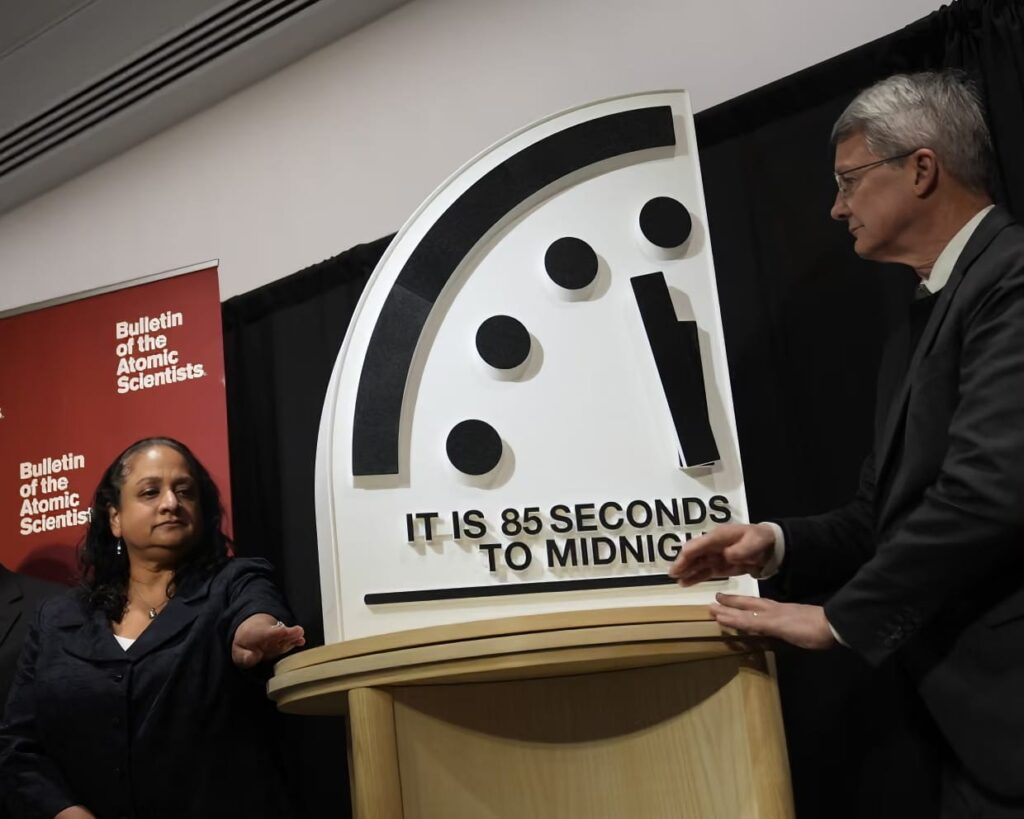
The Moment of Truth: Global risk experts unveil the Doomsday Clock’s fateful new setting at a Washington, D.C. town hall, signaling the world’s proximity to nuclear catastrophe.
Humanity is now closer to self-destruction than at any point in modern history. On January 27, 2026, the world received its starkest warning yet when the Bulletin of the Atomic Scientists reset its iconic timepiece. The hands now stand at just 85 seconds to midnight.
This shift marks a terrifying milestone. It is the closest the clock has ever been to the symbolic hour of global annihilation, moving four seconds forward from its previous setting.
For those seeing the headlines today and asking, “What does 85 seconds to midnight indicate?“—the answer is a converging emergency. It indicates that the safeguards meant to prevent civilization-ending catastrophe are eroding faster than they are being rebuilt. The Bulletin cited a toxic cocktail of nuclear brinkmanship, accelerating climate breakdown, and the unchecked rise of disruptive technologies as the driving forces behind this historic move.
Here is an in-depth look at the Doomsday Clock January 2026 announcement and the specific threats pushing the world to the brink.
A History of Warning: The Context of the 2026 Announcement
The Doomsday Clock is not a recent invention. It was created in 1947 by the Bulletin of the Atomic Scientists, a nonprofit founded by Manhattan Project scientists, including Albert Einstein and J. Robert Oppenheimer, who had seen firsthand the destructive power of nuclear technology.
The clock serves as a universally recognized metaphor representing how close humanity is to catastrophic collapse caused by its own man-made technologies. The setting is determined annually by the Bulletin’s Science and Security Board in consultation with its Board of Sponsors, which currently includes eight Nobel laureates.
It has moved backward and forward over the decades depending on geopolitical tension, but the trend in recent years has been relentlessly forward. This is the third time in four years the clock has moved closer to midnight, underscoring that global risks are compounding rather than receding.
The Core Question: Why Did the Doomsday Clock Move Closer to Midnight in 2026?
The decision to shave four critical seconds off the clock was driven by what scientists describe as a failure of global leadership to address existential threats. The Bulletin’s assessment paints a grim picture where diplomatic frameworks are crumbling under the weight of nationalism and military escalation.
The primary drivers for the 2026 reset fall into four critical categories:
1. The Nuclear Arms Control Collapse Impact
At the heart of the clock’s movement is a rapidly deteriorating nuclear landscape. According to Alexandra Bell, president and CEO of the Bulletin, “In terms of nuclear risks, nothing in the 2025 trended in the right direction.”
The most immediate concern is the imminent expiration of New START on February 5, 2026. This is the very last remaining nuclear arms control treaty between the United States and Russia, capping deployed strategic warheads at 1,550 per side. While Russian President Vladimir Putin proposed a one-year extension, the administration of US President Donald Trump has not formally responded, leaving the world facing an unregulated nuclear environment for the first time in decades.
Adding to the tension, Trump has ordered the US military to restart preparations for explosive nuclear testing, ending a 30-year pause. Scientists warn this will likely spur China to accelerate its own rapid nuclear expansion and modernization program.
These policy failures are set against the backdrop of hot wars. Russia’s ongoing war in Ukraine has featured the deployment of nuclear-capable hypersonic missiles and repeated nuclear signaling. Simultaneously, 2025 saw aerial attacks by Israel and the US on Iranian nuclear facilities and dangerous cross-border strikes between nuclear-armed India and Pakistan.
2. Space-Based Missile Defense Arms Race Risks
The threat is no longer contained to the planet’s surface. The Bulletin issued a specific warning this year regarding the acceleration of an arms race that extends into orbit.
Major powers are developing technologies that threaten strategic stability. A prime example cited is the United States’ plan to deploy the “Golden Dome,” a multilayered missile defense system that includes space-based interceptors. Scientists warn that such systems increase the likelihood of conflict in space and destabilize existing deterrence frameworks, potentially triggering a new, unpredictable arms race above the atmosphere.
3. The Climate Change Role in Doomsday Clock Setting
The environmental crisis featured prominently in the assessment, with scientists criticizing global responses that have shifted from “insufficient to actively destructive.
The role of climate change in the Doomsday Clock setting cannot be overstated. Atmospheric carbon dioxide levels have reached 150 percent of preindustrial levels. Following 2024—the warmest year in the 175-year temperature record—global temperatures in 2025 remained near historic highs.
The real-world impacts are accelerating. Europe recorded over 60,000 heat-related deaths for the third time in four years. Massive flooding displaced hundreds of thousands in the Congo River Basin, while record-breaking droughts afflicted the Amazon and southern Africa. The Bulletin noted that recent UN climate summits failed to prioritize phasing out fossil fuels, while the US has begun rolling back renewable energy initiatives and climate regulations.
4. The Artificial Intelligence Military Use Existential Threat
Emerging technologies acted as a significant “threat accelerant” in the 2026 assessment. The scientists are particularly alarmed by the unregulated integration of artificial intelligence into military systems, specifically regarding nuclear command and control structures. The potential for artificial intelligence military use as an existential threat arising from error or algorithmic hallucination in a high-stakes crisis is a growing concern.
Beyond the battlefield, AI is fueling what Nobel Peace Prize-winning journalist Maria Ressa described during the announcement as an “information Armageddon.” The rapid spread of disinformation through generative AI erodes the fact-based public debate necessary to solve global problems.
Furthermore, the past year saw renewed concerns over biosecurity, specifically the lack of international safeguards surrounding the laboratory synthesis of “mirror life,” which could pose unpredictable ecological threats.
A Crisis of Leadership
Underlying every one of these threats—nuclear, climatic, and technological—is a profound failure of global governance. The Bulletin points to a rise in “winner-takes-all great power competition” and nationalistic autocracy that prioritizes confrontation over cooperation.
When major powers refuse to engage on arms control, roll back climate agreements, and ignore technological guardrails, they act as threat accelerants.
Despite the terrifying setting of 85 seconds to midnight, the Bulletin emphasizes that this trajectory is not inevitable. The clock can be turned back. It requires immediate actions: renewed US-Russia arms talks, adherence to nuclear testing moratoriums, stronger climate policies, and global guidelines for military AI. The warnings are stark, but they are a call to action, not a notice of doom.